
On this page
- What is the difference?
- Why do joints matter so much in Tacoma?
- Are there reasons to choose sectional?
- What does seamless cost compared with sectional?
- What makes a good seamless installation?
- Should you replace sectional gutters with seamless?
- How do you tell which you have?
- What else should you check?
- How long does each type last?
- Can sectional and seamless be mixed?
- Does seamless cost more to repair?
- What does a seamless installation day look like?
What is the difference?
| Seamless | Sectional | |
|---|---|---|
| How it is made | Formed at the house from coil | Stock 10 or 20-foot lengths |
| Joints along a wall | None | One every 10 to 20 feet |
| Leak points | Corners, end caps, outlets | All of those plus every seam |
| Materials | Aluminum, steel, copper | Aluminum, steel, vinyl, copper |
| Installation | Contractor with a machine | Contractor or DIY |
| Look | Unbroken line | Visible seams |
| Maintenance | Less resealing | More resealing |
Why do joints matter so much in Tacoma?
Every joint in a gutter depends on sealant, rivets or solder. Sealant is the weak link. In Tacoma it sits under water for much of the year, since roughly three-quarters of the city's 40.8 inches of annual precipitation falls from October to March, by the normals on Wikipedia. Then it dries and warms in a short summer, with July averaging only about half an inch. That cycle makes sealant shrink, harden and crack. A sectional gutter might have a dozen seams on one side of a house; a seamless one has none along the run.
Joints also trap debris. The lip where two sections overlap catches fir needles and moss, which hold water against the seam and speed up its failure.
Are there reasons to choose sectional?
- DIY projects. Sectional gutter can be bought at a store and installed without a machine.
- Small structures. Sheds, carports and outbuildings with short runs.
- Repairs to existing sectional systems, matching what is there.
- Some copper work, where soldered sections are traditional.
What does seamless cost compared with sectional?
National guides put 5-inch seamless aluminum at about $9 to $13 a foot installed. Sectional materials are cheaper, but installed by a contractor the difference is often modest, and seamless saves on resealing over its life.
What makes a good seamless installation?
- Sound fascia and a drip edge at the roof edge.
- .032 aluminum or steel coil.
- Hidden hangers about every 2 feet, screwed into wood.
- Clean, riveted and sealed corners.
- Outlets where the water arrives, with 3x4 downspouts where possible.
- Correct pitch toward every outlet.
See seamless gutters for detail.
Should you replace sectional gutters with seamless?
If your sectional gutters leak at many seams, sag, or are near the end of their life, replacing them with seamless is usually worthwhile. If they are sound and only one or two joints drip, resealing is cheaper. The repair or replace guide covers the decision.
How do you tell which you have?
Look along the gutter from the ground. Sectional gutters show a joint, often a slightly wider band or a line of rivets, every 10 or 20 feet. Seamless gutters show joints only at corners and ends.
What else should you check?
Whether you have seamless or sectional, a few things decide how well the system works: the pitch toward each outlet, the size and number of downspouts, the condition of the fascia, and where each downspout lets its water go. A perfect seamless gutter on soft fascia, emptying beside a crawl space vent, is still a problem.
How long does each type last?
The metal itself lasts about the same in seamless and sectional form. The difference is in the joints. Sectional systems typically need resealing every few years at multiple seams; seamless systems need attention mainly at corners and end caps. Over 20 years, that difference adds up to fewer service visits and less water running down the fascia.
Can sectional and seamless be mixed?
Yes, for example when one side of a sectional system is replaced with seamless after damage. Profiles and colors can usually be matched. Over time, many owners replace the rest as the remaining sectional runs start to leak.
Does seamless cost more to repair?
Small repairs cost about the same. Damaged seamless runs are usually replaced along the whole wall rather than spliced, because a splice adds the seam you were trying to avoid.
What does a seamless installation day look like?
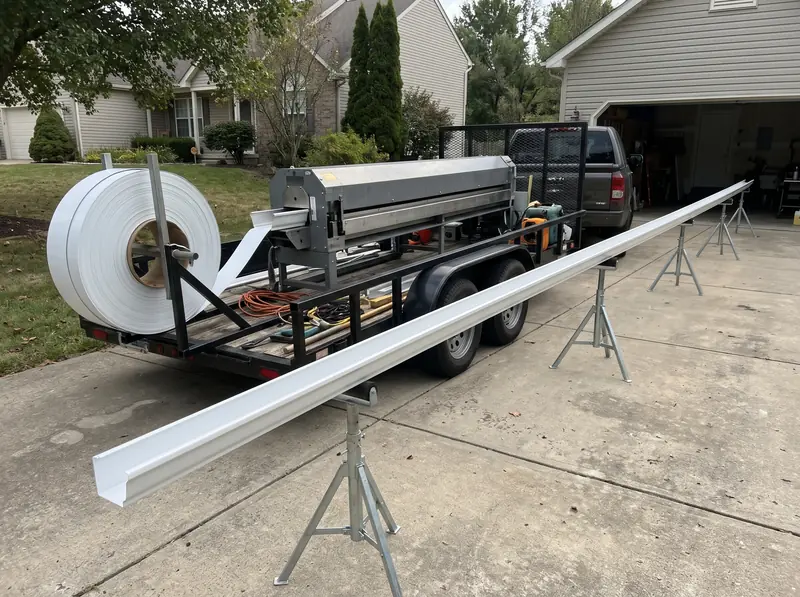
The contractor measures each wall, sets up the machine in the driveway, and forms each run to length. Runs are carried up, fitted with end caps and corners, and hung on hidden hangers. Downspouts go on last. On most houses the whole job takes a day, and the only joints left are at corners, ends and outlets.
How do you check a gutter contractor in Washington?
Washington does not license contractors the way some states do; instead the Department of Labor & Industries registers construction contractors, and registration requires a surety bond, liability insurance and a state business license. Work that adds to or changes a house, such as installing or replacing gutters, generally calls for a registered contractor, while plain gutter cleaning is one of the services the state lists as not needing registration. Look up any contractor's registration, bond and insurance on L&I's Verify a Contractor tool before you sign, and follow the state's hire-smart advice: get written bids and do not pay in full until the job is done. Ask, too, for a couple of addresses of recent jobs nearby and a written quote that spells out gutter size, metal and thickness, color, hanger type and spacing, downspout number and size, where each downspout drains, and who hauls the old metal away. In the North Slope and Wedge historic districts, check with the city's Historic Preservation Office before changing visible exterior details that need a permit.