
On this page
What does a new gutter installation include?
A full installation covers everything between the roof edge and the ground:
- Measuring every eave and deciding where outlets and downspouts go.
- Checking the roof edge: drip edge, gutter apron and the condition of the fascia boards and rafter tails.
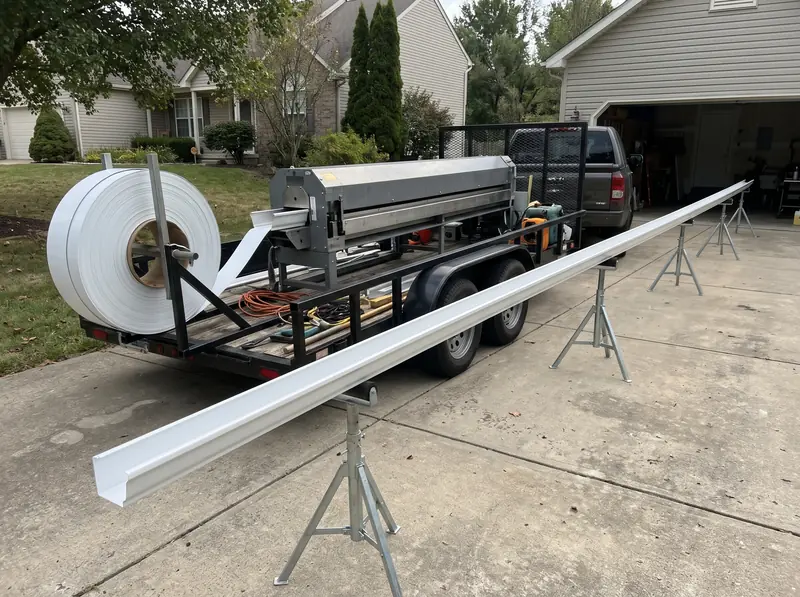
- Forming seamless runs at the house from coil, cut to the exact length of each wall.
- Hanging the gutter on hidden hangers at a slight slope toward each outlet.
- Cutting and sealing corners, end caps and outlets.
- Fitting downspouts with elbows and straps, and arranging where each one discharges.
- Removing the old gutters and cleaning up.
Which type of gutter suits a Tacoma house?
| Gutter | Best for | Notes |
|---|---|---|
| Seamless aluminum, 5-inch | Simple one-story and small two-story roofs | The most common choice; light, rust-free, dozens of colors |
| 6-inch K-style | Large or steep roofs, valleys, heavy tree cover | About 40 percent more capacity; pairs with 3x4 downspouts |
| Seamless steel | Houses under big limbs, exposed sites | Stiffer and harder to dent; needs paint intact to resist rust |
| Copper | Historic and high-end houses | Long-lived, weathers to a brown and green patina |
| Half-round | Victorian and early twentieth-century houses | Traditional look on round brackets; less capacity than K-style |
The overview of seamless gutters explains why most new installations are formed on site rather than pieced together.
How should gutters be sized for Tacoma rain?
Tacoma's rain is more about duration than intensity. The city averages about 40.8 inches a year, but over three-quarters of it falls between October and March, and November, December and January each average more than 6 inches, according to the normals on Wikipedia. Cloudbursts happen, but a typical winter day here is a steady rain that keeps a gutter running for hours. Two things follow. First, a well-placed 5-inch gutter is adequate on many simple roofs. Second, outlets and downspouts matter more than width, because a single plugged outlet will spill all day long.
Long soakers still come. In December 2023 an atmospheric river set a daily record of 2.01 inches at Seattle-Tacoma International Airport, and in December 2025 a slow, wandering atmospheric river broke duration records across western Washington, according to the state climatologist's office, and pushed Pierce County rivers to flood. Sizing for the worst week of the year, not the average day, is what separates a gutter that copes from one that spills.
Choose 6-inch when: - The roof is steep, large or has a valley pouring into one stretch of gutter. - An upper roof drains onto a lower roof and then into one gutter. - Douglas fir, cedar or maple hang over the roof and debris will build up between cleanings. - A run is long and cannot be given a second outlet.
The 5-inch vs 6-inch guide works through the calculation.
How are gutters attached properly?
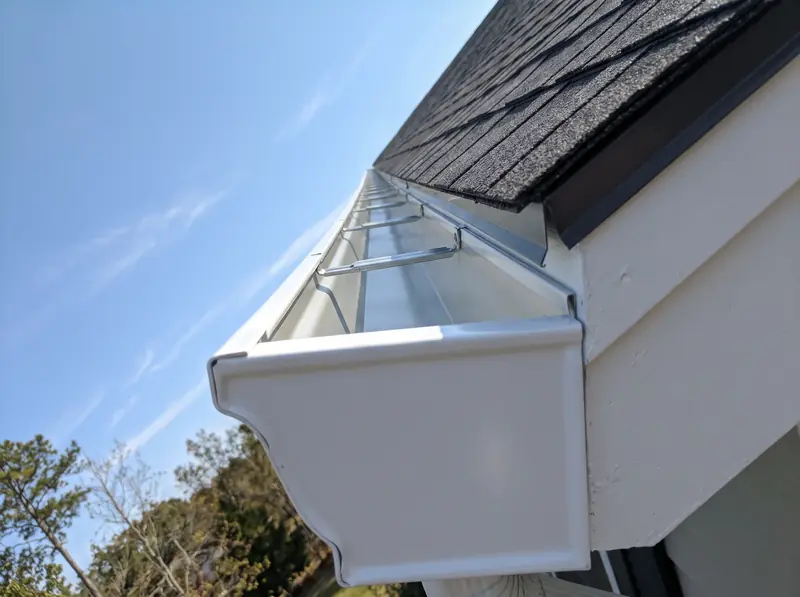
Hidden hangers clip into the front lip and screw through the back into the fascia, ideally reaching the rafter tails behind it. Spacing of about 2 feet is common, closer at corners and under trees, where a run full of wet needles weighs far more than one full of water. Screws hold where old spikes and ferrules work loose, and on Tacoma's many older houses that is the single biggest reason gutters pull away.
The slope is set at about a quarter inch for every 10 feet. Long walls are often pitched from the middle toward outlets at both ends.
What happens at the roof edge?
A drip edge or gutter apron under the first course of shingles sends water into the trough instead of letting it wick behind the gutter onto the fascia. Many older Tacoma roofs were built without one, and the result is a band of rot, green streaks and moss along the fascia. A contractor installing new gutters should check for it and add it where it is missing.
Where should downspout water go?
A gutter system is only as good as its discharge. Water dumped next to the house finds its way into crawl spaces and basements, softens beds and paths, and on sloping lots can wash soil toward the neighbors. The usual options:
- Extensions and splash blocks that carry water several feet from the wall.
- Tightlines, solid pipe buried to a lawful outlet, dry well or rain garden.
- Rain barrels, which Pierce County notes can catch some of the roughly 30,000 gallons a year that run off an average 2,000-square-foot roof.
- Rain gardens, shallow planted basins the City of Tacoma and Pierce County publish guidance on.
The downspouts page and the drainage guide go into detail.
What does installation cost?
National guides from Angi and This Old House put seamless aluminum at roughly $9 to $13 a foot installed for 5-inch and $12 to $18 for 6-inch, steel at $6 to $14 and copper at $25 to $40. Height, steep or mossy roofs, many corners, fascia repair, tightlines and removing the old system all add to the total. The Tacoma cost guide explains what drives the number.
What should a written quote name?
- Gutter size and profile, such as 5-inch or 6-inch K-style, or half-round.
- Metal and thickness, for example .032 aluminum, Galvalume steel or 16-ounce copper.
- The finish color, and whether downspouts match it or the siding.
- Hanger type and spacing, and what they fasten into.
- The number, size and position of downspouts, and where each one discharges.
- Any fascia, soffit or drip edge work, priced as a separate line.
- Removal and haul-away of the old system.
A quote that names these things is easy to compare with another. A single lump sum with none of them is not.
How do you check a gutter contractor in Washington?
Washington does not license contractors the way some states do; instead the Department of Labor & Industries registers construction contractors, and registration requires a surety bond, liability insurance and a state business license. Work that adds to or changes a house, such as installing or replacing gutters, generally calls for a registered contractor, while plain gutter cleaning is one of the services the state lists as not needing registration. Look up any contractor's registration, bond and insurance on L&I's Verify a Contractor tool before you sign, and follow the state's hire-smart advice: get written bids and do not pay in full until the job is done. Ask, too, for a couple of addresses of recent jobs nearby and a written quote that spells out gutter size, metal and thickness, color, hanger type and spacing, downspout number and size, where each downspout drains, and who hauls the old metal away. In the North Slope and Wedge historic districts, check with the city's Historic Preservation Office before changing visible exterior details that need a permit.