
On this page
How does micro-mesh work?
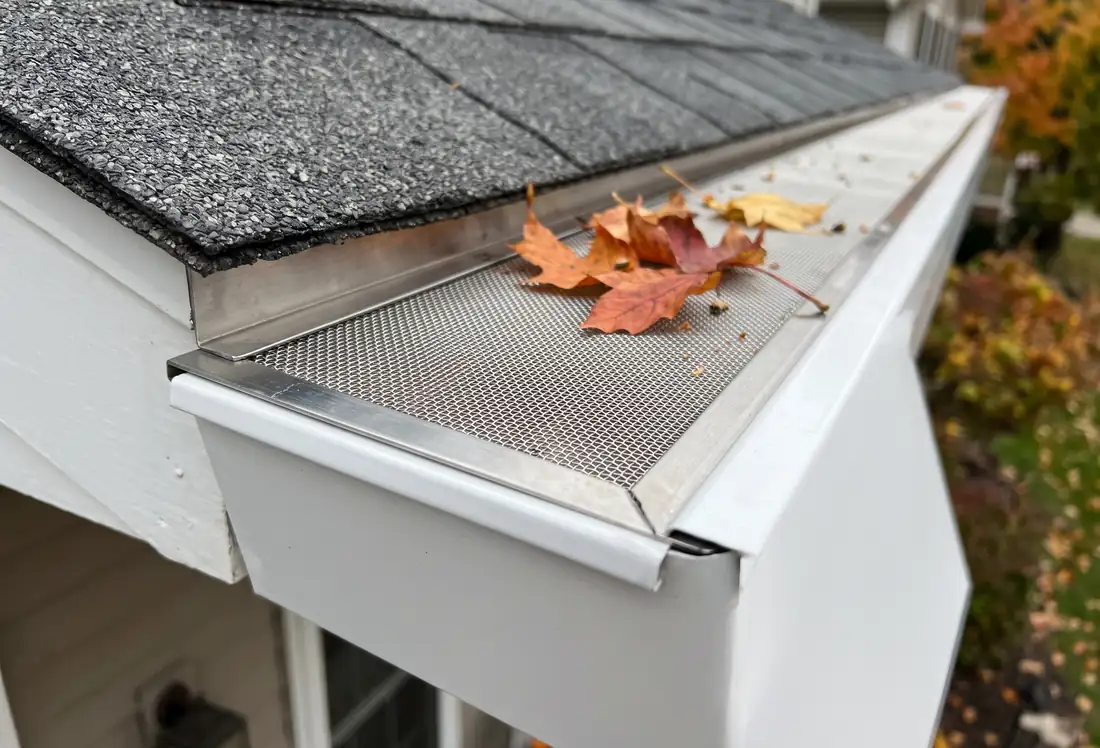
A stainless steel mesh, with openings far smaller than a needle or seed, is stretched over a perforated aluminum frame. The frame clips into the gutter's front lip and fastens at the back to the fascia, the drip edge or under the shingles, depending on the system. Water clings to the mesh by surface tension and drops into the gutter. Debris sits on top, where wind and rain move much of it off.
Why does it suit the South Sound?
| Debris | Coarse screen | Micro-mesh |
|---|---|---|
| Bigleaf maple leaves | Stopped | Stopped |
| Douglas fir and cedar needles | Pass through or lodge in openings | Stopped |
| Maple seeds and alder catkins | Pass through | Stopped |
| Cones | Stopped | Stopped |
| Moss clumps | Small pieces pass through | Stopped |
| Shingle grit | Passes through | Most stopped |
The city's average canopy is modest, about 20 percent in 2018, but many Tacoma streets and nearby suburbs have big conifers overhanging roofs. Those are where micro-mesh earns its keep.
What does a good installation look like?
- Clean and flush the gutters and downspouts.
- Check and repair pitch, joints and hangers. Guards should never go on a sagging gutter.
- Fit panels along each run, trimmed around hangers and corners.
- Fasten securely at front and back, following the roof manufacturer's guidance.
- Detail corners and valleys carefully, since gaps appear there first.
- Set the angle so debris slides off rather than settling.
What maintenance does micro-mesh still need?
- Brush off the top once or twice a year under heavy trees, more on shaded mossy runs.
- Look from the ground after big autumn storms for debris sitting on the mesh.
- Flush downspouts every year or two, since fine grit still passes.
- Check corners and valleys for gaps.
What does micro-mesh cost?
Professionally installed stainless micro-mesh is priced by the foot, and can cost as much per foot as the gutter itself. DIY products are cheaper but often use plastic or painted mesh and lighter frames. The guide are gutter guards worth it compares the cost with years of cleaning.
Which parts come up in a guard quote?
| Term | What it means on a Tacoma house |
|---|---|
| Micro-mesh guard | A fine stainless mesh over a frame that covers the gutter, stopping fir needles, maple seeds, moss and grit while letting water through. |
| Drip edge | An L-shaped metal flashing at the edge of the roof deck. It throws water forward into the gutter so it cannot wick back onto the fascia, which matters in a climate that stays damp for months. |
| Roof valley | Where two roof slopes meet in a channel. A valley gathers water from both slopes and dumps it into one short stretch of gutter. |
| Outlet | The hole in the gutter bottom where a downspout connects, usually with a drop sleeve riveted in. |
| Roof moss | Moss that grows on shaded, damp shingles through the wet months. As it dries and breaks up, clumps wash into gutters and plug outlets. |
Which houses benefit most from micro-mesh?
- Houses under Douglas fir, cedar or pine, where needles fall all year.
- Two-story and hillside homes where cleaning means tall ladders.
- Shaded roofs with moss that breaks off through the winter.
- Houses where overflow has already damaged fascia or soaked the crawl space.
In the Tacoma area that often means parts of the North End and Northeast Tacoma, University Place, Lakewood and the wooded hillsides of Puyallup and Fife Heights, though a single large fir can make micro-mesh worthwhile on any street.
What are the limits of micro-mesh?
It does not fix a sagging, leaking or badly pitched gutter; it sits on top of one. It still needs occasional brushing, especially on shaded runs. And fine grit from aging shingles can pass through, so downspouts still need flushing every year or two.
How do you check a gutter contractor in Washington?
Washington does not license contractors the way some states do; instead the Department of Labor & Industries registers construction contractors, and registration requires a surety bond, liability insurance and a state business license. Work that adds to or changes a house, such as installing or replacing gutters, generally calls for a registered contractor, while plain gutter cleaning is one of the services the state lists as not needing registration. Look up any contractor's registration, bond and insurance on L&I's Verify a Contractor tool before you sign, and follow the state's hire-smart advice: get written bids and do not pay in full until the job is done. Ask, too, for a couple of addresses of recent jobs nearby and a written quote that spells out gutter size, metal and thickness, color, hanger type and spacing, downspout number and size, where each downspout drains, and who hauls the old metal away. In the North Slope and Wedge historic districts, check with the city's Historic Preservation Office before changing visible exterior details that need a permit.