
On this page
Why choose aluminum?
| Quality | What it means on a Tacoma house |
|---|---|
| Rust-free | No red streaks through a long wet season |
| Light | Less load on older fascia and rafter tails |
| Formed seamless on site | One piece per wall, joints only at corners |
| Many colors | Matches white trim, dark windows, stained cedar or brick |
| Moderate cost | About $9 to $13 a foot for 5-inch, $12 to $18 for 6-inch, nationally |
| Recyclable | Old gutters and offcuts can be recycled |
Prices are national ranges from Angi.
What gauge should you ask for?
Aluminum gutter coil commonly comes in .027 and .032 inch. The difference sounds small, but it shows up on the house:
- .027 is the economy choice. It dents more easily from ladders, falling branches and wet snow sliding off the roof.
- .032 is stiffer, holds a straight line on long runs, and stands up better to the knocks a gutter takes over 20 years.
Under Tacoma's firs and maples, where limbs come down in windstorms and gutters are cleaned from ladders more often, .032 is usually worth the difference. Ask for the gauge to be named on the quote.
Which color suits the house?
Most Tacoma houses fall into a few groups:
- Painted lap siding with white trim, common on North End and Proctor houses: white or a color matched to the trim.
- Dark modern infill and townhomes: black, dark gray or bronze.
- Stained cedar shingles and Craftsman details: dark bronze or a muted brown.
- Brick: brick red, clay or bronze, often with downspouts matched to the wall rather than the trim.
Downspouts can match the gutter or the wall they run down. Matching the wall makes them almost disappear.
How does aluminum handle the local climate?
Damp air is not a problem for aluminum, which forms its own protective oxide. Near the water, along Ruston Way, Point Ruston, Browns Point, Steilacoom or the University Place shoreline, salt in the air can slowly attack scratched or bare metal, so keeping the baked finish intact and using compatible fasteners matters. Aluminum should not touch copper, which causes corrosion, so copper flashings and aluminum gutters need a barrier between them.
Cold is rarely an issue. Tacoma's record lows reached 5°F in November and 6°F in December by the extremes listed on Wikipedia, but long freezes are uncommon. When wet snow does slide off a roof, thicker coil and closer hangers are what keep the gutter from bending.
How should aluminum gutters be fastened?
Hidden hangers about every 2 feet, screwed through the back of the gutter into the fascia and, where possible, the rafter tails. Stainless or coated screws resist corrosion. Avoid spikes and ferrules; they loosen in wood that stays damp for months.
Which parts come up in an aluminum quote?
| Term | What it means on a Tacoma house |
|---|---|
| Coil stock | The roll of pre-painted aluminum, steel or copper fed through a gutter machine to form a seamless run. |
| Gauge | The thickness of the metal. Aluminum gutter is usually .027 or .032 inch; the thicker coil holds its shape better under ladders, limbs and snow. |
| Hidden hanger | A bracket that clips under the front lip of the gutter and screws through the back into the fascia, out of sight from the street. |
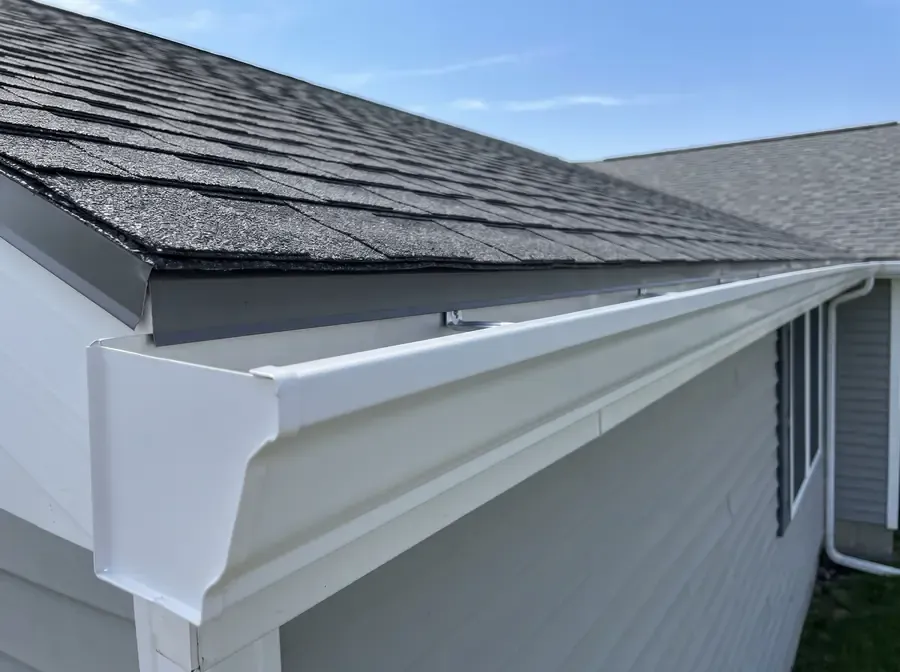
| Drip edge | An L-shaped metal flashing at the edge of the roof deck. It throws water forward into the gutter so it cannot wick back onto the fascia, which matters in a climate that stays damp for months. |
| Fascia | The trim board across the rafter ends. Every hanger fastens into it, so soft or rotten fascia has to be replaced before new gutters go up. |
| Downspout | The vertical pipe that carries water to the ground. Standard sizes are 2x3 and 3x4 inches; the larger one moves roughly twice the water. |
What should a written quote name?
- Gutter size and profile, such as 5-inch or 6-inch K-style, or half-round.
- Metal and thickness, for example .032 aluminum, Galvalume steel or 16-ounce copper.
- The finish color, and whether downspouts match it or the siding.
- Hanger type and spacing, and what they fasten into.
- The number, size and position of downspouts, and where each one discharges.
- Any fascia, soffit or drip edge work, priced as a separate line.
- Removal and haul-away of the old system.
A quote that names these things is easy to compare with another. A single lump sum with none of them is not.
How do you check a gutter contractor in Washington?
Washington does not license contractors the way some states do; instead the Department of Labor & Industries registers construction contractors, and registration requires a surety bond, liability insurance and a state business license. Work that adds to or changes a house, such as installing or replacing gutters, generally calls for a registered contractor, while plain gutter cleaning is one of the services the state lists as not needing registration. Look up any contractor's registration, bond and insurance on L&I's Verify a Contractor tool before you sign, and follow the state's hire-smart advice: get written bids and do not pay in full until the job is done. Ask, too, for a couple of addresses of recent jobs nearby and a written quote that spells out gutter size, metal and thickness, color, hanger type and spacing, downspout number and size, where each downspout drains, and who hauls the old metal away. In the North Slope and Wedge historic districts, check with the city's Historic Preservation Office before changing visible exterior details that need a permit.