
On this page
How big should downspouts be?
| Downspout | Relative capacity | Best for |
|---|---|---|
| 2x3 rectangular | Baseline | Small roofs, 5-inch gutters, sheds |
| 3x4 rectangular | About twice 2x3 | Most houses; standard with 6-inch |
| 3-inch round | Similar to 2x3 | Half-round systems on small roofs |
| 4-inch round | Similar to 3x4 | Half-round on larger roofs, copper systems |
| 4x5 and larger | Commercial | Large roofs and commercial buildings |
Bigger downspouts also clog less. A cone or a clump of moss that wedges in a 2x3 elbow often passes straight through a 3x4.
Where should downspouts go?
- At the low ends of runs and under valleys, where most water arrives.
- Every 30 to 40 feet on long runs, so water does not travel too far in the gutter.
- Away from walkways, steps and doors, where water freezes on the rare cold nights or makes a slip hazard.
- Where the discharge can go somewhere sensible, which matters as much as the gutter end.
Where should the water go?
| Option | How it works | Best for |
|---|---|---|
| Extension | A pipe or hinged section carrying water several feet out | Most houses; simple and cheap |
| Splash block | A tray spreading water and protecting the ground | Downspouts already discharging away from the house |
| Tightline | Solid pipe buried to a lawful outlet, dry well or rain garden | Narrow lots, lawns, paths in the way |
| Pop-up emitter | A cap at the end of a buried line that opens under pressure | Lawns where an extension is in the way |
| Rain barrel | Stores roof water for summer watering | Gardeners; needs an overflow |
| Rain garden | A planted basin that soaks up runoff | Yards with draining soil and space away from the house |
Pierce County estimates that an average 2,000-square-foot roof sheds about 30,000 gallons of runoff a year. That water has to go somewhere, and close to a foundation is the worst place for it.
Why is drainage important on Tacoma houses?
Many Tacoma houses sit on crawl spaces, and many others have basements cut into slopes. Downspouts emptying next to the wall keep the soil there saturated through the wet season, feeding moisture into crawl spaces, damp basement corners and rotting sills. On sloping lots in the North End, Northeast Tacoma and University Place, concentrated discharge can also erode beds and paths or send water toward neighbors and bluffs.
What do the city and county suggest?
The City of Tacoma's Environmental Services Department encourages rain gardens and notes that the Tacoma-Pierce County area gets 40 to 50 inches of rain a year. The city does not provide rain barrels or rebates for them but explains how to use them. Pierce County's Let the Rain Soak In program and its rain garden handbook cover sizing and placement, including the need for every rain garden to have an overflow that does not point at buildings or sidewalks.
What about the aquifer in South Tacoma?
Part of South Tacoma lies over an aquifer that supplies up to half of the city's water in peak summer months, protected by the South Tacoma Groundwater Protection District. Ordinary roof water is not a hazard, but any plan to infiltrate stormwater on a property there is worth checking against current city rules.
Which parts come up in a downspout quote?
| Term | What it means on a Tacoma house |
|---|---|
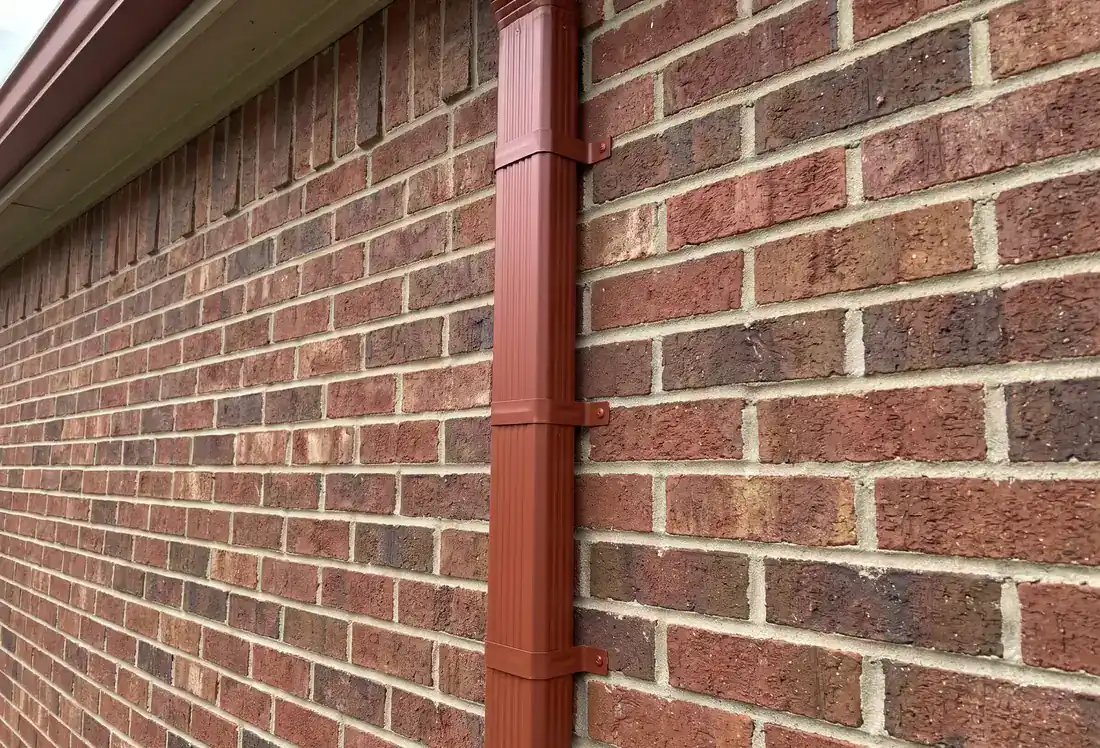
| Downspout | The vertical pipe that carries water to the ground. Standard sizes are 2x3 and 3x4 inches; the larger one moves roughly twice the water. |
| A elbow | A downspout elbow that bends forward or back, used to bring the pipe off the overhang and against the wall. |
| B elbow | A downspout elbow that bends sideways, used to steer the pipe around a window or along a wall. |
| Downspout extension | A length of pipe or a hinged section that carries water several feet from the wall before letting it go. |
| Splash block | A concrete or plastic tray under a downspout that spreads the water and keeps it from digging a hole. |
| Tightline | Solid pipe laid underground from a downspout to a lawful outlet, a dry well or a rain garden. In the Puget Sound region it is the usual name for a buried downspout drain. |
| Pop-up emitter | A spring-loaded cap at the end of a buried line that opens when water pushes up and closes again when the line drains. |
| Dry well | A buried gravel pit or chamber that takes downspout water and lets it soak slowly into the ground. It only works where the soil drains. |
| Rain barrel | A covered container under a downspout that stores roof water for summer watering, with an overflow aimed away from the house. |
| Rain garden | A shallow planted basin that takes roof runoff and lets it soak in. Pierce County and the City of Tacoma both publish guidance for building one. |
What should a written quote name?
- Gutter size and profile, such as 5-inch or 6-inch K-style, or half-round.
- Metal and thickness, for example .032 aluminum, Galvalume steel or 16-ounce copper.
- The finish color, and whether downspouts match it or the siding.
- Hanger type and spacing, and what they fasten into.
- The number, size and position of downspouts, and where each one discharges.
- Any fascia, soffit or drip edge work, priced as a separate line.
- Removal and haul-away of the old system.
A quote that names these things is easy to compare with another. A single lump sum with none of them is not.
How do you check a gutter contractor in Washington?
Washington does not license contractors the way some states do; instead the Department of Labor & Industries registers construction contractors, and registration requires a surety bond, liability insurance and a state business license. Work that adds to or changes a house, such as installing or replacing gutters, generally calls for a registered contractor, while plain gutter cleaning is one of the services the state lists as not needing registration. Look up any contractor's registration, bond and insurance on L&I's Verify a Contractor tool before you sign, and follow the state's hire-smart advice: get written bids and do not pay in full until the job is done. Ask, too, for a couple of addresses of recent jobs nearby and a written quote that spells out gutter size, metal and thickness, color, hanger type and spacing, downspout number and size, where each downspout drains, and who hauls the old metal away. In the North Slope and Wedge historic districts, check with the city's Historic Preservation Office before changing visible exterior details that need a permit.