
On this page
- How are gutters sized?
- How does Tacoma's rain change the picture?
- When is 5-inch enough?
- When should you choose 6-inch?
- How do the two compare?
- Why do downspouts matter as much as gutter size?
- What about older houses?
- How do you decide for your house?
- What does an atmospheric river do to a 5-inch gutter?
- Is upsizing worth it on an existing house?
- What else affects capacity?
How are gutters sized?
Gutter sizing balances three things:
- Roof area draining to each gutter and outlet, adjusted for pitch, since steeper roofs catch more wind-driven rain.
- Rainfall intensity, the heaviest rain likely in a short period.
- Outlets and downspouts, which set how fast water leaves the gutter.
A gutter that is wide enough but drains through one small downspout will still overflow. A narrower gutter with plenty of large outlets often copes well.
How does Tacoma's rain change the picture?
Tacoma averages about 40.8 inches of precipitation a year by the 1991 to 2020 normals listed on Wikipedia. That is less than many eastern cities, and Tacoma's rain usually falls steadily rather than in violent bursts. On intensity alone, 5-inch gutters are adequate for many local roofs.
Two things push the other way. First, the season is long: November, December and January each average more than 6 inches, and a gutter may run for days. Second, atmospheric rivers bring periods of heavy rain. One in December 2023 set a daily record of 2.01 inches at Seattle-Tacoma International Airport. In those conditions any extra capacity gives a margin for partly blocked outlets.
When is 5-inch enough?
- A one-story or simple two-story house with moderate roof pitch.
- No valleys pouring into short runs.
- Runs under about 40 feet, or with outlets at both ends.
- Few trees overhanging the roof.
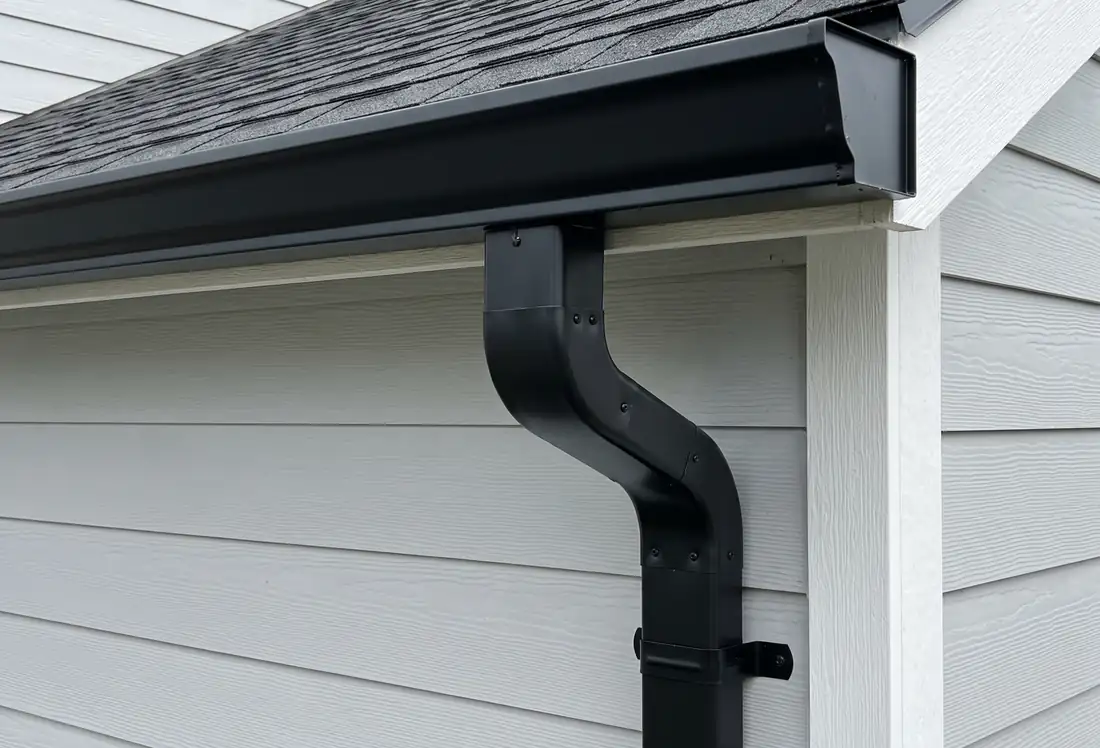
- 3x4 downspouts or enough 2x3 downspouts to keep up.
When should you choose 6-inch?
- Large roof planes draining to one wall.
- Steep pitches, roughly 8/12 or more.
- Valleys pouring into corners.
- Upper roofs draining onto lower roofs.
- Long runs that cannot be given a second outlet.
- Douglas fir, cedar or maple overhead, so debris builds up between cleanings.
- Metal roofs, which shed water faster.
How do the two compare?
| 5-inch K-style | 6-inch K-style | |
|---|---|---|
| Relative capacity | Baseline | Roughly 40 percent more |
| Usual downspout | 2x3 or 3x4 | 3x4 |
| National installed price, aluminum | About $9 to $13 a foot | About $12 to $18 a foot |
| Look on small houses | In proportion | Can look heavy |
| Debris tolerance | Less | More |
Prices are national ranges from Angi.
Why do downspouts matter as much as gutter size?
Because the gutter only holds water on its way to the outlet. Moving from 2x3 to 3x4 downspouts roughly doubles what each outlet can take. Adding a second outlet on a long run halves the water each one handles. On many Tacoma houses, more and bigger downspouts solve overflow without changing the gutter at all. See downspouts and drainage.
What about older houses?
Half-round gutters carry less than K-style of the same width. On larger Victorian or Tudor roofs, 6-inch half-round with 4-inch round downspouts is common. See half-round gutters.
How do you decide for your house?
Walk around the house and note:
- Which roof slopes are largest and steepest.
- Where valleys meet the gutters.
- Where upper roofs drain onto lower ones.
- Which runs are longest, and where the downspouts are.
- What trees overhang the roof.
A contractor will measure roof areas and suggest sizes. The 6-inch gutters page has more detail.
What does an atmospheric river do to a 5-inch gutter?
On a typical winter day a 5-inch gutter on a modest roof copes easily. During an atmospheric river, rain can stay heavy for a day or more, and any weak point shows. In December 2025 a slow-moving one broke rainfall-duration records across western Washington, according to the state climatologist's office. The gutter rarely fails because of its width alone. It fails because a partly plugged outlet, a 2x3 downspout or a valley pouring into a corner can not keep up for hours on end. A 6-inch gutter with 3x4 downspouts gives that margin; so do extra outlets and guards on a 5-inch system.
Is upsizing worth it on an existing house?
If clean 5-inch gutters overflow at the same spots in every long rain, and adding outlets or bigger downspouts has not fixed it, upsizing those runs is usually worth it. If overflow only happens when the gutters are full of needles, cleaning or guards are the cheaper fix. Many houses get 6-inch on the largest slope and keep 5-inch elsewhere.
What else affects capacity?
Pitch, outlet placement, debris and how the roof edge meets the gutter all change how much a gutter really carries. A 6-inch gutter pitched the wrong way or emptying into a blocked downspout will still overflow.
How do you check a gutter contractor in Washington?
Washington does not license contractors the way some states do; instead the Department of Labor & Industries registers construction contractors, and registration requires a surety bond, liability insurance and a state business license. Work that adds to or changes a house, such as installing or replacing gutters, generally calls for a registered contractor, while plain gutter cleaning is one of the services the state lists as not needing registration. Look up any contractor's registration, bond and insurance on L&I's Verify a Contractor tool before you sign, and follow the state's hire-smart advice: get written bids and do not pay in full until the job is done. Ask, too, for a couple of addresses of recent jobs nearby and a written quote that spells out gutter size, metal and thickness, color, hanger type and spacing, downspout number and size, where each downspout drains, and who hauls the old metal away. In the North Slope and Wedge historic districts, check with the city's Historic Preservation Office before changing visible exterior details that need a permit.