
On this page
Why choose copper?
| Quality | What it means |
|---|---|
| Very long life | Often outlasts the roof and the house's paint several times over |
| Soldered joints | No sealant to dry out at corners and seams |
| Patina | Brown, then green; no painting needed |
| Traditional look | Suits Victorian, Tudor, Colonial Revival and Craftsman houses |
| Weight and strength | Stiffer than aluminum, resists dents |
| Cost | About $25 to $40 a foot installed, nationally |
Prices are national ranges from This Old House.
Which copper gutter styles are there?
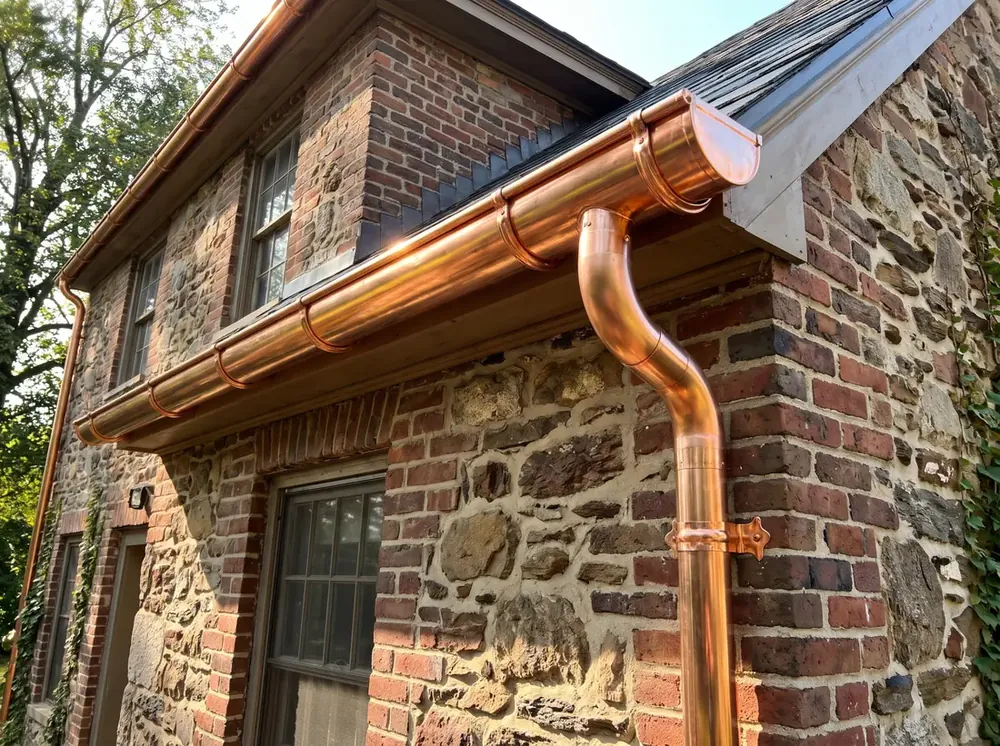
Half-round on round brackets is the traditional choice for older houses, paired with round downspouts. The look suits many of the large Victorian and early twentieth-century houses on the North Slope and around Wright Park.
K-style copper carries more water than half-round of the same width and works on a wider range of houses.
Box gutters lined with copper are found on some older Tacoma houses and commercial buildings, built into the roof edge.
What thickness of copper is used?
Gutters are commonly made from 16-ounce or 20-ounce copper, meaning the weight of a square foot of sheet. 16-ounce is standard for most residential work; 20-ounce is stiffer and used for larger gutters, long runs and premium work. Ask for the weight to be named on the quote.
How does copper weather in Tacoma?
Bright copper darkens to brown within months in damp air. The familiar green patina forms over years, and tends to form faster close to salt water, along Commencement Bay, the Narrows and the Steilacoom shoreline. The patina protects the metal. Runoff from copper can stain light stone, masonry and paint, so downspouts are best placed where the staining will not matter, and drip edges keep water off the face of walls.
What has to go with a copper gutter?
- Copper or compatible hangers and brackets, never galvanized steel or aluminum in contact.
- Copper downspouts, round or rectangular, with copper straps.
- Copper or compatible flashings at the roof edge.
- Soldered seams at corners and end caps rather than sealant.
- Sound fascia, since a copper system is expected to last decades.
Aluminum and copper should never touch. In wet conditions, contact between them corrodes the aluminum, sometimes quickly.
Is copper worth it?
For a historic house, a high-end house, or an owner planning to stay for decades, copper's long life and appearance can justify the cost. For most houses, seamless aluminum or steel gives good service for far less money. The metals guide compares them.
Which parts come up in a copper quote?
| Term | What it means on a Tacoma house |
|---|---|
| Half-round gutter | A semicircular trough hung from round brackets, typical of Victorian and early twentieth-century houses and often made in copper. |
| Bracket hanger | A curved support that cradles a half-round gutter from below and screws to the fascia. |
| Patina | The brown, then green, layer that forms on copper as it weathers. It protects the metal and needs no paint. |
| Box gutter | A gutter built into the roof structure and lined with metal, found on some older North End houses and downtown buildings. |
| Conductor head | A box at the top of a downspout that collects water from a gutter or scupper, common on flat roofs and older brick buildings. |
| Downspout | The vertical pipe that carries water to the ground. Standard sizes are 2x3 and 3x4 inches; the larger one moves roughly twice the water. |
What should a written quote name?
- Gutter size and profile, such as 5-inch or 6-inch K-style, or half-round.
- Metal and thickness, for example .032 aluminum, Galvalume steel or 16-ounce copper.
- The finish color, and whether downspouts match it or the siding.
- Hanger type and spacing, and what they fasten into.
- The number, size and position of downspouts, and where each one discharges.
- Any fascia, soffit or drip edge work, priced as a separate line.
- Removal and haul-away of the old system.
A quote that names these things is easy to compare with another. A single lump sum with none of them is not.
How do you check a gutter contractor in Washington?
Washington does not license contractors the way some states do; instead the Department of Labor & Industries registers construction contractors, and registration requires a surety bond, liability insurance and a state business license. Work that adds to or changes a house, such as installing or replacing gutters, generally calls for a registered contractor, while plain gutter cleaning is one of the services the state lists as not needing registration. Look up any contractor's registration, bond and insurance on L&I's Verify a Contractor tool before you sign, and follow the state's hire-smart advice: get written bids and do not pay in full until the job is done. Ask, too, for a couple of addresses of recent jobs nearby and a written quote that spells out gutter size, metal and thickness, color, hanger type and spacing, downspout number and size, where each downspout drains, and who hauls the old metal away. In the North Slope and Wedge historic districts, check with the city's Historic Preservation Office before changing visible exterior details that need a permit.