
On this page
- How do the three metals compare?
- Why is aluminum the usual choice?
- When does steel make sense?
- When does copper make sense?
- How does the local climate affect the choice?
- What about mixing metals?
- Which should you choose?
- What about vinyl and zinc?
- How much does metal thickness matter?
- Does the color affect lifespan?
- How do the metals look as they age?
How do the three metals compare?
| Aluminum | Steel (Galvalume or galvanized) | Copper | |
|---|---|---|---|
| National installed price | About $9 to $13 a foot (5-inch), $12 to $18 (6-inch) | About $6 to $14 a foot | About $25 to $40 a foot |
| Typical life | 20 years or more | Varies with coating | Many decades |
| Rust | None | Possible where coating is damaged | None |
| Dent resistance | Moderate; .032 better | High | High |
| Weight | Light | Heavier | Heavier |
| Colors | Dozens of baked finishes | Fewer, painted | Natural; weathers to patina |
| Seamless on site | Yes | Yes | Yes, or soldered sections |
| Best for | Most houses | Houses under limbs, exposed sites | Historic and high-end houses |
Prices are national ranges from Angi and This Old House.
Why is aluminum the usual choice?
It is light, rust-free, easy to form seamless on site, and available in many colors at a moderate price. For most houses in Tacoma's neighborhoods and suburbs, .032 seamless aluminum on hidden hangers is a sound, long-lasting system. See aluminum gutters.
When does steel make sense?
- Houses under big Douglas firs or maples where limbs fall in windstorms.
- Exposed sites where ladders and wind knock gutters about.
- Owners who want a stiffer gutter that holds a straight line.
Galvalume, steel coated with an aluminum-zinc alloy, resists corrosion well as long as the coating is intact. Scratches and cut edges are where rust starts, so careful installation matters.
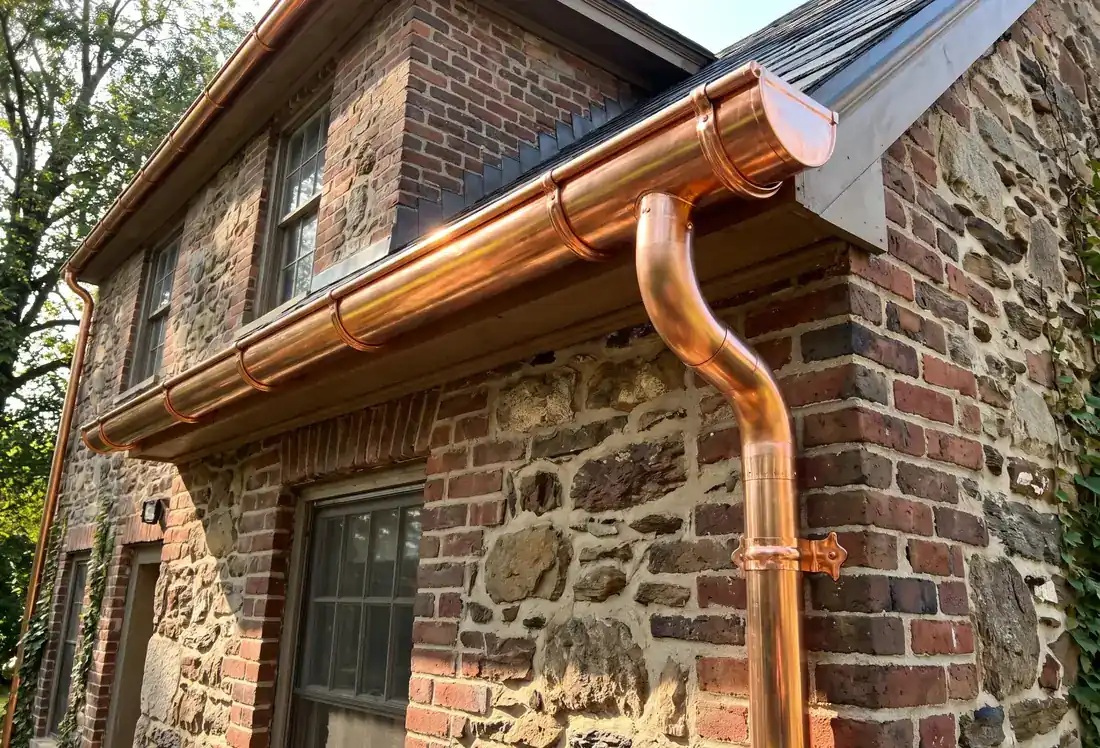
When does copper make sense?
- Historic houses on the North Slope, in the Stadium District or in Steilacoom.
- High-end houses where the look matters.
- Owners planning to stay for decades.
Copper weathers from bright to brown to green, can stain light masonry below, and must never touch aluminum. See copper gutters.
How does the local climate affect the choice?
Damp. Tacoma averages about 40.8 inches of precipitation a year, mostly October to March, by the normals listed on Wikipedia. All three metals cope with damp; what fails first is sealant, fasteners and the wood behind.
Salt air. Houses near Commencement Bay, Ruston Way, Browns Point, the Narrows and the Steilacoom and University Place shoreline see more salt. Intact finishes and compatible fasteners matter more there.
Wind and limbs. Western Washington's windstorms bring down limbs; the November 2024 bomb cyclone left more than 656,000 customers statewide without power. Stiffer metal and closer hangers resist damage better.
Cold. Freezes are short and uncommon, but wet snow sliding off a roof can fold thin aluminum. Thicker metal helps.
What about mixing metals?
Different metals in contact in wet conditions can corrode, the less noble one going first. Copper and aluminum is the classic bad pairing. Keep each system consistent: copper gutters with copper downspouts, hangers and flashings; aluminum with aluminum or compatible fasteners.
Which should you choose?
| If you want | Choose |
|---|---|
| Best value for most houses | Seamless .032 aluminum |
| Strength under trees | Steel, or .032 aluminum with close hangers |
| Traditional look and longest life | Copper |
| Many color choices | Aluminum |
What about vinyl and zinc?
Vinyl sectional gutter is inexpensive and sold for DIY. It becomes brittle with age and sun, sags more easily under wet debris and moss, and is rarely recommended for houses in a climate where gutters stay loaded for months.
Zinc is a premium metal used on some high-end European-style houses. Like copper it weathers to a natural finish and lasts many decades, but it is uncommon in the Tacoma area and needs specialist installers.
How much does metal thickness matter?
As much as the metal itself. Thin .027 aluminum dents from ladders and limbs and can bend under wet snow sliding off a roof. .032 aluminum, Galvalume steel and 16-ounce copper all hold their shape far better. On any of them, hidden hangers about every 2 feet into sound wood are what keep the gutter straight.
Does the color affect lifespan?
Factory-baked finishes on aluminum and steel last many years; color choice does not change durability much. What matters is that the finish stays intact, especially near salt water, and that scratches from installation are touched up.
How do the metals look as they age?
Painted aluminum and steel keep their color for many years, fading slowly on sunny elevations. Copper changes most: bright at first, brown within a year or two, and green over a longer period, often faster near salt water. If the look of the house matters as much as the drainage, that change is part of the decision.
How do you check a gutter contractor in Washington?
Washington does not license contractors the way some states do; instead the Department of Labor & Industries registers construction contractors, and registration requires a surety bond, liability insurance and a state business license. Work that adds to or changes a house, such as installing or replacing gutters, generally calls for a registered contractor, while plain gutter cleaning is one of the services the state lists as not needing registration. Look up any contractor's registration, bond and insurance on L&I's Verify a Contractor tool before you sign, and follow the state's hire-smart advice: get written bids and do not pay in full until the job is done. Ask, too, for a couple of addresses of recent jobs nearby and a written quote that spells out gutter size, metal and thickness, color, hanger type and spacing, downspout number and size, where each downspout drains, and who hauls the old metal away. In the North Slope and Wedge historic districts, check with the city's Historic Preservation Office before changing visible exterior details that need a permit.