
On this page
- What is a good cleaning schedule?
- How does the gutter year run in Tacoma?
- What are the signs gutters need cleaning now?
- What should a cleaning include?
- What makes Tacoma gutters fill faster?
- Is it safe to clean your own?
- When should you consider guards instead?
- What happens if gutters go uncleaned for a winter?
- Does the roof type change the schedule?
- A simple calendar for a typical Tacoma house
What is a good cleaning schedule?
| Trees near the roof | Suggested schedule |
|---|---|
| None within reach | Every year or two, plus a look after storms |
| A few broadleaf trees | Once a year, late November or December |
| Douglas fir, cedar or pine | Twice a year: late autumn and spring |
| Big maples or alders overhead | Twice a year, timed after leaf fall and seed drop |
| Heavy conifer overhang and mossy roof | Two or three times a year, or micro-mesh guards |
| Micro-mesh guards fitted | Brush off once or twice a year; flush downspouts every year or two |
How does the gutter year run in Tacoma?
| Months | What happens | Cleaning |
|---|---|---|
| September and October | Rain returns; needles and dust from summer wash down | Optional light clean before the rains |
| November and December | Maple and alder leaves fall; wettest weeks begin | Main clean after leaves are down |
| January to March | Moss breaks off shaded roofs; storms drop needles and twigs | Check outlets; clean if overflowing |
| April to June | Maple seeds, catkins, pollen, cones | Spring clean under heavy trees |
| July and August | Driest months; needles and grit dry into crust | Good time for repairs |
Tacoma's normals, as listed on Wikipedia, show November, December and January each above 6 inches of precipitation and July at about half an inch. A gutter full of leaves at the start of that wet stretch spills for months.
What are the signs gutters need cleaning now?
- Water spills over the front during ordinary rain.
- Plants, grass or seedlings are growing in the gutter.
- Downspouts stay quiet during rain or gurgle.
- Gutters sag where debris has built up.
- Water stains or green streaks appear on the siding or fascia.
- Birds or insects are nesting in the gutter.
What should a cleaning include?
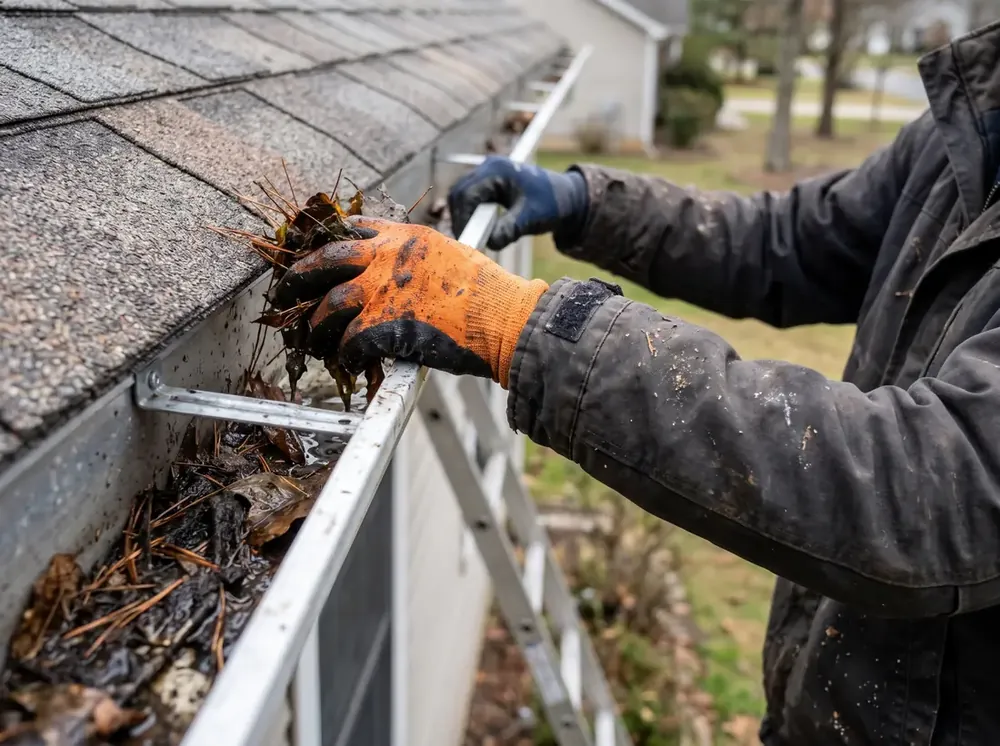
- Hand-clearing every run.
- Clearing outlets and flushing downspouts.
- Checking underground lines.
- Noting loose hangers, leaking joints, low spots and damage.
- Removing debris from the site.
See gutter cleaning for detail.
What makes Tacoma gutters fill faster?
Conifers. Douglas fir and cedar shed needles all year, more after wind.
Moss. Shaded roofs grow moss through the wet months, and clumps wash into gutters. See the moss guide.
Big maples. Bigleaf maple leaves are large enough to plug an outlet in one storm.
Wind. Storms bring down needles, twigs and small branches all at once.
Is it safe to clean your own?
From a sturdy ladder on firm, level ground, in dry weather, with a helper, one-story gutters are a reasonable DIY job. Leave second stories, steep or mossy roofs and sloping lots to a contractor. Never stand on a wet or mossy roof, never lean a ladder on the gutter, and keep away from service lines.
When should you consider guards instead?
If you clean more than twice a year, or overflow has already damaged fascia, micro-mesh guards may cost less over time. See are gutter guards worth it.
What happens if gutters go uncleaned for a winter?
Debris packs at the outlets first. Water then backs up, overflows the front lip and soaks the fascia and siding. Wet debris adds weight, loosening hangers. Downspouts plug, so water pours over the gutter beside the foundation. By spring, the fascia may be soft, the gutter may sag, and the crawl space may have been damp for months. Seedlings and moss can root in the trough. A cleaning that would have taken an hour becomes a repair.
Does the roof type change the schedule?
Older asphalt roofs shed more granules, which settle as heavy grit. Cedar shake roofs shed fragments and grow moss readily. Metal roofs shed debris quickly into the gutter. Each can call for an extra cleaning on top of the tree-based schedule above.
A simple calendar for a typical Tacoma house
- Late September: look from the ground; clear any obvious summer debris at outlets.
- Late November or early December: main clean once most leaves are down; flush downspouts.
- February: check outlets after winter storms, especially under firs and on mossy roofs.
- April or May: spring clean for seeds, catkins and moss; note any repairs for the dry season.
How do you check a gutter contractor in Washington?
Washington does not license contractors the way some states do; instead the Department of Labor & Industries registers construction contractors, and registration requires a surety bond, liability insurance and a state business license. Work that adds to or changes a house, such as installing or replacing gutters, generally calls for a registered contractor, while plain gutter cleaning is one of the services the state lists as not needing registration. Look up any contractor's registration, bond and insurance on L&I's Verify a Contractor tool before you sign, and follow the state's hire-smart advice: get written bids and do not pay in full until the job is done. Ask, too, for a couple of addresses of recent jobs nearby and a written quote that spells out gutter size, metal and thickness, color, hanger type and spacing, downspout number and size, where each downspout drains, and who hauls the old metal away. In the North Slope and Wedge historic districts, check with the city's Historic Preservation Office before changing visible exterior details that need a permit.